

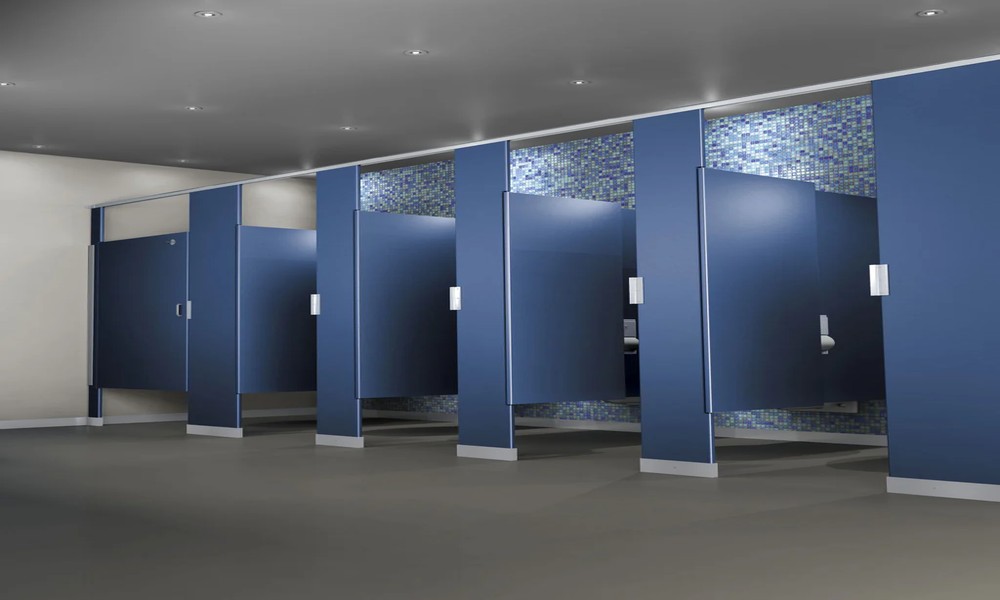
ADA-compliant restroom partition layout involves dimensional requirements that interact with plumbing fixture placement, door swing clearances, and ambulatory accessible stall configurations in ways that require verification at multiple design stages. Post-occupancy ADA audits of newly constructed commercial buildings consistently identify restroom stall configurations among the most common accessibility violations.
What Are the Dimensional Requirements for a Wheelchair Accessible Stall?
The ADA Standards for Accessible Design require wheelchair accessible stalls to meet 4 dimensional requirements:
- Minimum 60-inch clear width measured to the inside face of partition panels and pilasters, not to pilaster centerlines
- Minimum 56-inch clear depth for wall-hung toilets, or 59-inch clear depth for floor-mounted toilets
- 60-inch minimum turning circle clearance within the stall
- Door clear opening width of 32 inches minimum, located at the end wall or side wall
Architects who measure to pilaster centerlines rather than inside faces produce stalls consistently smaller than the ADA minimum when panel and pilaster face widths are subtracted.
What Are the Ambulatory Accessible Stall Requirements?
Multi-stall restrooms with 6 or more toilet compartments are required in many jurisdictions to include at least 1 ambulatory accessible stall in addition to the wheelchair accessible stall. Ambulatory accessible stalls must meet 3 requirements:
- 36-inch clear interior width, verified against the inside face of panels rather than nominal stall dimension
- Parallel grab bars on both side walls
- Door hardware operable without tight grasping or twisting
Which Hardware Components Most Frequently Fail ADA Compliance Review?
Specifiers selecting ADA compliant toilet partitions should verify compliance of 3 hardware elements that are frequently non-compliant even in products marketed as ADA-accessible:
- Inside door pulls: U-shaped pulls or lever handles required; thumb-turn latches that require wrist twisting are non-compliant
- Outside door hardware: must also be operable without grasping or twisting, not just the interior side
- Coat hooks: must be within the 15 to 48-inch forward reach range when mounted inside the accessible stall
When Should ADA Layout Verification Occur During Design?
ADA layout verification is most effective at 3 design stages, each catching different error types:
- Design development: verify clear dimension calculations against the selected partition pilaster width before finalizing stall counts and restroom footprint
- Construction documents: verify that the plumbing fixture locations do not conflict with the required clear floor spaces
- Submittal review: verify that the hardware package submitted for the accessible stall includes ADA-compliant components on both inside and outside door faces.