

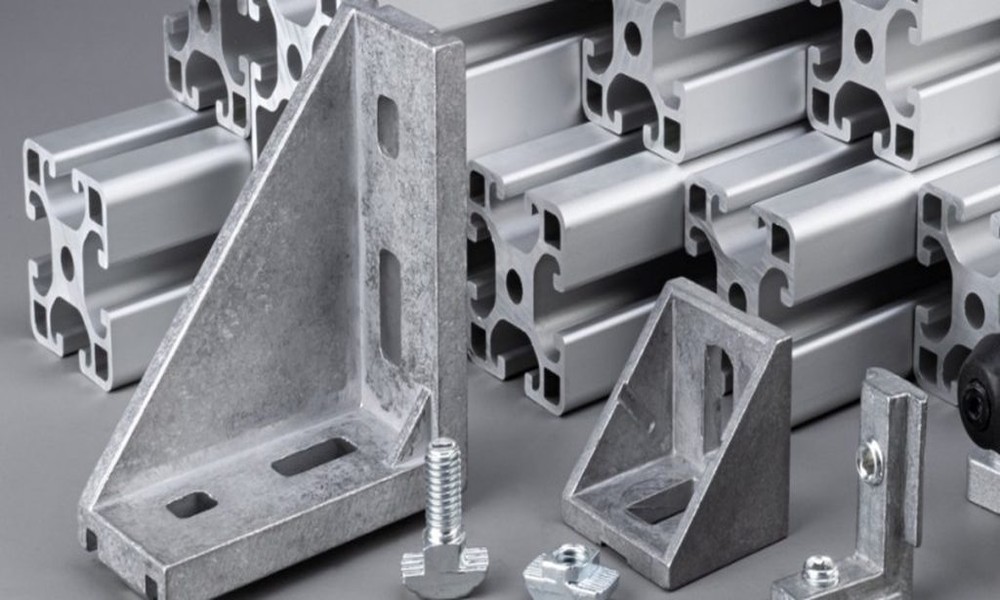
Lean manufacturing focuses on maximising efficiency while minimising waste, making flexibility and adaptability essential in modern production environments. Across UK industries, manufacturers are increasingly adopting modular solutions to improve workflows and respond quickly to changing demands.
One such solution is modular aluminium framing, which offers a practical and scalable approach to building workstations, production lines, and support structures.
What Is Modular Aluminium Framing?
Modular aluminium framing systems are built using extruded aluminium profiles with T-slots, allowing components to be easily connected using standard fixings. This creates a flexible framework that can be assembled, adjusted, and expanded without the need for welding or specialised fabrication.
These systems are commonly used to build:
- Workstations and assembly benches
- Conveyor frames and material handling systems
- Machine enclosures and guarding
- Storage racks and shelving units
Their modular nature makes them particularly well suited to lean manufacturing environments.
Supporting Lean Manufacturing Principles
Lean manufacturing is built around key principles such as reducing waste, improving efficiency, and enabling continuous improvement. Modular aluminium framing aligns closely with these goals.
Key advantages include:
- Reduced material waste: Components can be reused or reconfigured rather than discarded
- Improved workflow efficiency: Custom layouts can be created to streamline production
- Faster implementation: Systems can be assembled quickly with minimal disruption
- Continuous improvement: Layouts can be easily modified as processes evolve
This flexibility allows manufacturers to adapt quickly without significant downtime or cost.
Flexibility for Changing Production Needs
One of the biggest challenges in manufacturing is responding to changes in product design, demand, or production processes. Traditional fixed structures can be costly and time-consuming to modify.
Modular aluminium framing offers a more adaptable alternative:
- Frames can be extended or reduced in size
- Components can be repositioned without dismantling entire systems
- Additional accessories can be integrated as needed
This makes it easier to adjust production lines and workspaces to meet new requirements.
Cost Efficiency Over Time
While the initial investment in modular aluminium systems may be comparable to traditional materials, the long-term cost benefits are significant.
- Reduced need for custom fabrication
- Lower maintenance requirements
- Reusability of components across different projects
- Minimal downtime during modifications
These factors contribute to a more cost effective solution over the lifecycle of a manufacturing setup.
Improved Ergonomics and Workplace Organisation
Lean manufacturing also places importance on creating efficient and safe working environments. Modular aluminium framing can be used to design ergonomic workstations that improve productivity and reduce strain on workers.
Features may include:
- Adjustable heights and layouts
- Integrated storage and tool holders
- Clear organisation of materials and components
- Improved accessibility for operators
Well designed workspaces support both efficiency and employee wellbeing.
Applications Across UK Industry
Modular aluminium framing is widely used in:
- Automotive and aerospace manufacturing
- Electronics assembly and production
- Packaging and logistics operations
- Food and beverage processing facilities
- General engineering and fabrication workshops
Its versatility makes it suitable for businesses of all sizes looking to implement lean principles.
Frequently Asked Questions
Is modular aluminium framing strong enough for industrial use?
Yes. It provides a robust and stable structure suitable for a wide range of industrial applications when properly designed.
Can systems be reconfigured easily?
Yes. One of the main benefits is the ability to modify layouts without extensive downtime or specialised tools.
Is it suitable for small manufacturing setups?
Absolutely. Modular systems are scalable and can be adapted for both small workshops and large production facilities.
Does it support automation systems?
Yes. Aluminium framing is commonly used to support conveyors, robotics, and automated equipment.
Final Thoughts
Modular aluminium framing offers a flexible and efficient solution for supporting lean manufacturing environments in the UK. Its ability to adapt to changing production needs, reduce waste, and improve workflow efficiency makes it an ideal choice for modern industrial operations.
By investing in modular systems, manufacturers can create scalable, cost-effective setups that evolve alongside their processes.